
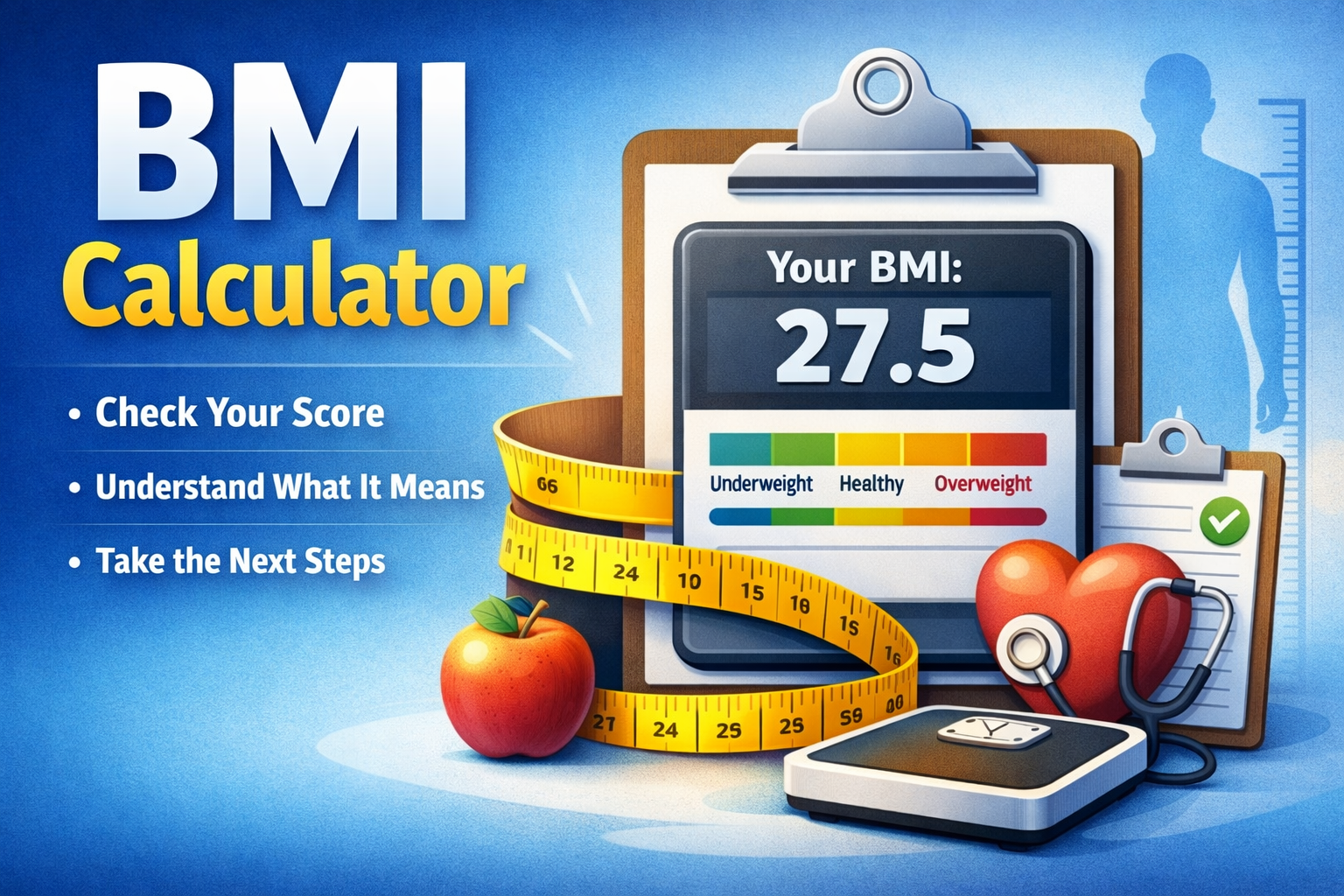
BMI Calculator: a practical way to understand your weight today
If you search for a BMI calculator, you usually want one thing. A quick, reliable answer about where you stand. Not a lecture. Not medical jargon. Just clarity.
This article is built around that idea. We will use the calculator as the center of the explanation and then layer in context so the number actually means something in daily life.
Start with the number, not the theory
A BMI calculator takes two inputs:
- Your height
- Your weight
From those, it gives you a single number. That number is your Body Mass Index.
Most people stop here. That is where confusion starts.
BMI is not a diagnosis. It is a screening tool. Think of it like a speedometer. It tells you how fast you are going, not why.
What your BMI result usually looks like
Once you enter your details, the calculator places you in a range.
| BMI Range | Category |
|---|---|
| Below 18.5 | Underweight |
| 18.5–24.9 | Healthy weight |
| 25–29.9 | Overweight |
| 30 and above | Obese |
This table is everywhere online. What is missing is how to use it correctly.
How people actually use a BMI calculator in real life
Most users fall into one of these situations:
- Checking progress after weight loss
- Confirming what a doctor mentioned casually
- Comparing their number with friends or family
- Filling out a fitness or insurance form
In all these cases, BMI works best as a starting signal, not a final answer.
The biggest mistake people make with BMI
The most common mistake is treating BMI as a verdict.
BMI does not know:
- Your muscle mass
- Your body fat percentage
- Your age-related changes
- Your activity level
A strength-trained person can show “overweight” on a BMI calculator while being very fit. On the other hand, someone with low muscle mass can fall into the “healthy” range while carrying excess body fat.
When a BMI calculator is actually very useful
BMI shines in these situations:
- Population-level screening
- Tracking long-term trends
- Identifying sudden changes in weight status
- Flagging possible health risks early
Doctors often use BMI as a first filter. If it raises concern, they look deeper.
BMI for adults vs children: do not mix them up
Adult BMI calculators use fixed ranges.
Child and teen BMI works differently. It compares weight and height against age and sex percentiles. Using an adult BMI calculator for a child gives misleading results.
If the calculator does not ask for age and sex for children, it is not the right tool.
A smarter way to read your BMI number
Instead of asking “Is my BMI good or bad?”, ask these questions:
- Has my BMI changed quickly in the last few months?
- Does my BMI match how my body feels and performs?
- Do I have other risk factors like inactivity or poor diet?
BMI becomes useful when combined with common sense.
BMI vs other health measurements
BMI is not alone. It works best when paired with:
- Waist circumference
- Body fat percentage
- Blood pressure
- Blood sugar levels
If BMI is the headline, these are the supporting details.
Why BMI calculators are still everywhere
BMI survives because it is:
- Fast
- Free
- Easy to standardize
- Good enough for large-scale screening
It is not perfect, but it is practical. That is why health systems still rely on it.
If your BMI worries you, what to do next
Do not panic. Do not self-diagnose.
Use the result as a prompt to:
- Review eating habits
- Increase daily movement
- Talk to a healthcare professional
- Track changes over time, not daily
BMI is a conversation starter, not a conclusion.
Visual guide: how BMI works at a glance

Height and weight combined into one index


Quick takeaway
A BMI calculator gives you a number.
Your job is to give that number context.
Used correctly, BMI is helpful. Used blindly, it is misleading. The difference is how you read it.